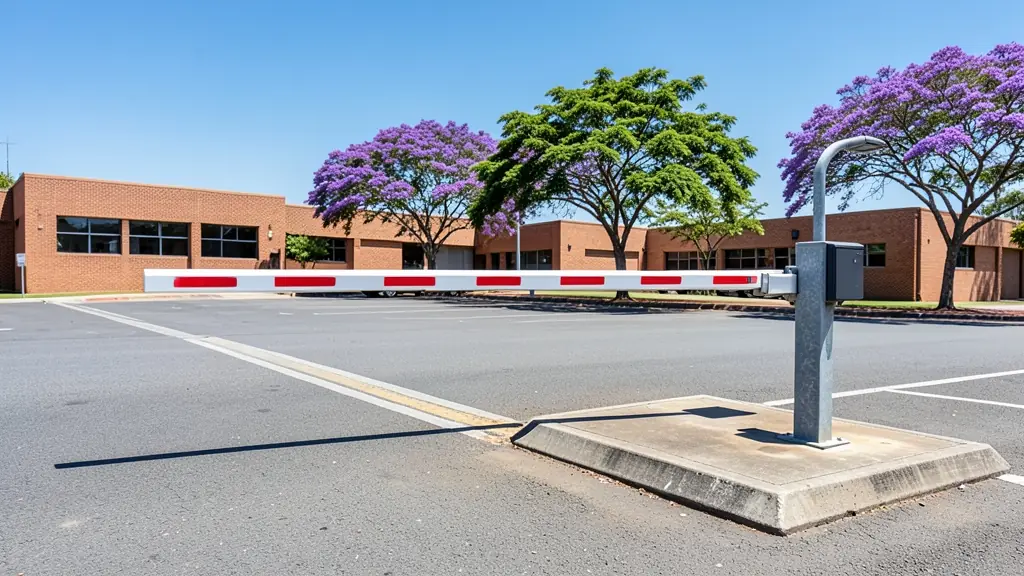
Every day a boom gate rises and falls hundreds of times at a busy entrance, and drivers only notice it when it does something wrong: stays down for a resident, lifts for the car that tailgated, or comes down on a bonnet. The motor is the easy part. A good boom installation is mostly about the arm that suits the lane, the loops cut into the road, the way each kind of driver is let through, and what happens when the power goes off or a delivery truck clips the arm.
The arm: length, type and visibility
Most arms are somewhere between 3 m and 6 m long, measured to cover the lane with a little overlap onto the island. A longer arm needs a bigger motor and a support post at the tip, and it catches more wind. Under a low roof, such as a basement car park, a folding or articulated arm bends as it rises so it clears the slab.
Ask for reflective bands, and on dark roads, LED lights along the arm. A light arm that snaps cleanly is often cheaper to live with than a rigid one that bends the motor's shaft when a bakkie drives into it.
Loops in the road
An induction loop is a coil of wire laid in a saw cut in the tar or concrete. When a car's metal body sits over it, the loop detector knows. A safety loop under the arm stops it dropping while a car is beneath it, and a closing loop past the boom lowers the arm once the car has gone, so the next driver cannot follow on the same read.
Loops do not see people or most motorbikes, so pair them with a safety beam. On gravel farm roads, loops need a concrete pad to sit in.
How each driver gets the boom up
- Residents and staff: a remote, a UHF tag on the windscreen read from a few metres away, a card or fingerprint reader on a gooseneck post, or number plate recognition.
- Visitors: an intercom to the guardhouse or the unit, or a one time code typed on a keypad. See gate intercoms.
- Trucks at a depot: a guard with a handheld scanner, a long range tag, or a camera that logs the plate.
- Farm and mine roads: a manual boom with a padlock and counterweight, where nobody needs automation and no power reaches.
When it goes wrong: symptom and cause
- Arm stays up after the car leaves: a faulty closing loop or a cracked saw cut letting in water.
- Arm drops on a slow car: no safety loop, or one set too short.
- Dead in a power failure: a flat or old battery; many boom motors run off a battery charged from the mains, so check it yearly. The gate motor calculator shows the cycles a battery gives.
- Arm snapped overnight: vandalism or a truck; keep a spare arm on site.
What to put in your request
- Give the lane width and the roof height
- Say entrance, exit or both directions
- Say how residents and visitors open it
- Ask for safety and closing loops by name
- Ask the price of a replacement arm
Boom Gates for homes, estates, offices, factories and schools
- Homes: uncommon at a single house, but used on long private roads shared by a few homes
- Estates, complexes and body corporates: separate resident and visitor booms at the gatehouse, each with its own loops and reader
- Offices and practices: a boom at the business park car park, opened by staff tags and a visitor intercom
- Factories, warehouses and mines: booms at the depot truck gate, the weighbridge and the staff car park
- Shops, restaurants and filling stations: car park entry and exit booms at a shopping centre or a filling station's back yard
- Schools, colleges and creches: a staff car park boom that keeps parents' cars out of the drop off area
- Clinics, hospitals and pharmacies: a boom at the hospital staff parking and the ambulance bay
- Farms, smallholdings and lodges: a manual boom with a padlock across the farm road where there is no power