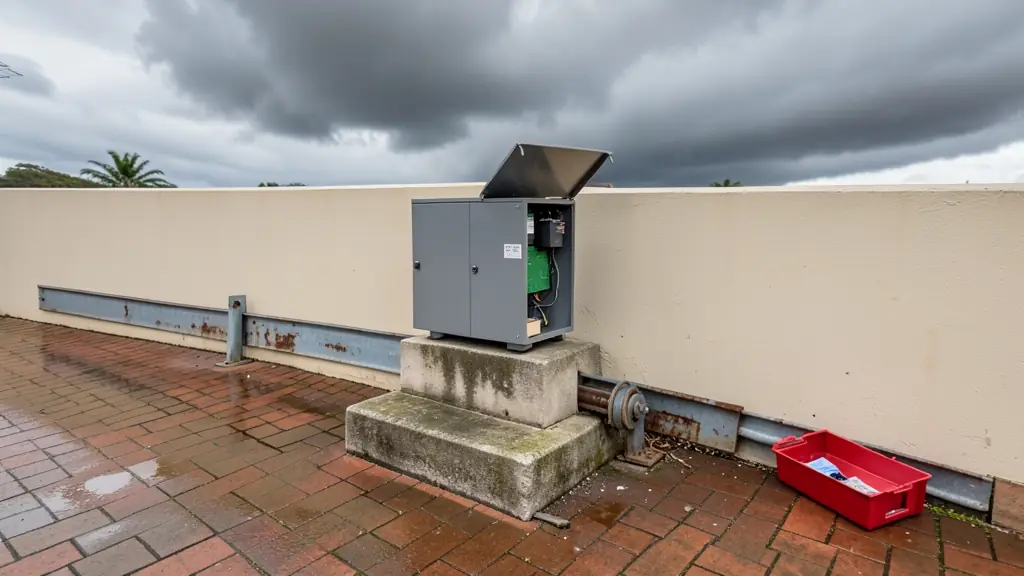
Your gate stopped halfway with the car in the road, or it opens on its own at two in the morning, or it simply hums. Before you search for a repair near you, know what the symptom usually points to: a fair share of call-outs turn out to be a flat battery or a nest of ants. Below is a symptom list, a safe routine to try yourself, what Highveld storms do to the electronics, and when to replace a part or the motor.
Symptom: usual cause
- Stops halfway, or reverses: something blocking the safety beams, the collision sensing tripping on a stiff gate, or a weak battery.
- Opens on its own: a remote button stuck in a pocket or a car, a faulty trigger wire from an intercom or keypad, or a damaged receiver.
- Remotes do nothing: flat remote batteries, the receiver lost its codes, or a power fault at the motor.
- Hums but does not move: the gate is jammed, the manual release is half engaged, or the gearbox or pinion is worn.
- Works with the mains on, dies in load shedding: an old battery that no longer holds a charge.
- Beeps or flashes a pattern: the controller is reporting a fault; look it up in the manual.
What you can check yourself, safely
- Look along the gate path for a stone, a branch or a toy, and wipe the beam lenses.
- Use the manual release with the key, push the gate by hand and feel whether it runs freely. If it is hard to push, the gate is the problem, not the motor.
- Lift the cover and look for ants, and for chewed or burnt wiring. Do not spray insecticide on the board.
- Check the mains isolator and any fuse reachable without opening live parts.
- Try a second remote.
Resetting a gate motor, on many controllers, means switching off the mains, disconnecting the battery briefly and reconnecting; the limits may then need setting again. Follow the motor's manual or leave it to the technician.
Lightning, surges and the power coming back
A summer storm can send a surge down the mains, the intercom cable or the beam wiring and kill the control board, the receiver or the charger in one strike. The same can happen when the power returns after load shedding. A gate that died in a storm needs a technician, not a reset.
Ask about surge protection on the mains feed and a proper earth when the board is replaced, and ask your insurer about storm cover before old parts are thrown away. Intercom units on the same cable often fail at the same time; see intercom systems.
Repair the part or replace the motor
Battery: the most common replacement and the cheapest fix for a gate that fails in power cuts. Control board or receiver: replaced after surge or ant damage, often with remotes coded again. Pinion and rack: replaced together when the teeth are worn or skipping. Gearbox or the whole motor: worth weighing up when parts are hard to find or the motor was always too small. The gate motor calculator shows the class your gate needs, and gate motors covers choosing a new one.
What to put in your request
- Describe exactly what the gate does or does not do
- Say whether it started after a storm
- Say whether the gate pushes freely by hand
- Ask for the call-out fee and parts priced apart
- Ask to keep or see the replaced parts
Gate Motor Repairs for homes, estates, offices, factories and schools
- Homes: a driveway gate stuck in load shedding, a dead battery or ants in the board
- Estates, complexes and body corporates: a busy complex gate on a service plan so it never stops at rush hour
- Offices and practices: the staff parking gate that stops opening for remotes or the reception button
- Factories, warehouses and mines: a heavy depot gate with a worn pinion and rack after years of truck traffic
- Shops, restaurants and filling stations: the yard gate behind a shop that will not close after the last delivery
- Schools, colleges and creches: the parents' gate that failed after a storm the week before term
- Clinics, hospitals and pharmacies: a clinic gate that must open for an ambulance, repaired the same day
- Farms, smallholdings and lodges: a farm gate motor hit by lightning or with a solar charger that stopped charging