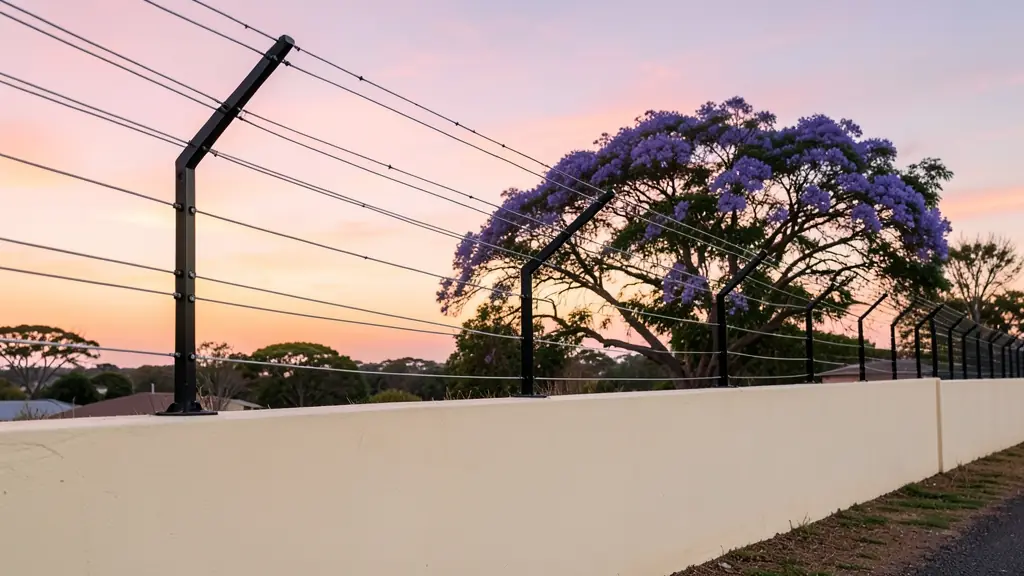
Most people price an electric fence by the metre and stop there. The metre rate matters, but what keeps a fence working for years is decided elsewhere: how high the brackets stand above the wall, how many strands they carry, whether the energiser is split into zones so one fault does not kill the whole fence, how good the earth is, and whether the alarm reaches someone who will respond. This page covers wall top and free standing fences, the energiser and its accessories, the certificate you must get, and solar fences for farms.
Wall top or free standing
Most suburban homes and complexes get a wall top fence: steel brackets bolted to the top of the boundary wall or palisade carrying the strands. Straight brackets suit a plain wall; angled brackets lean outwards to keep climbers further away. More strands and taller brackets cost more but leave fewer gaps to slip through.
A free standing fence runs on its own posts along a perimeter with no wall: a factory yard, a smallholding, a game camp. It needs strainer posts at the corners, intermediate posts and droppers to keep the strands apart, and a cleared strip on each side so grass does not touch the bottom wire. Use the electric fence calculator to count wire, brackets, signs and earth spikes for your length.
The energiser and what hangs off it
- The energiser: sends short high voltage pulses down the strands and watches for a cut, a short or a drop in voltage.
- Zones: splitting a long fence into zones means a branch on the back wall does not alarm the front, and the keypad tells you where to look.
- Keypad and siren: arm, disarm and see which zone has faulted.
- Battery: keeps the fence live through load shedding. A tired battery is a common reason a fence goes quiet.
- Earth spikes: several, well spaced, in soil that stays damp. A poor earth gives a weak shock and false alarms.
- Alarm link: wire the energiser into the alarm panel so armed response hears about a cut fence. Plan the crossing over a motorised gate with the installer.
SANS 10222-3, the certificate and the signs
Electric fences in South Africa fall under SANS 10222-3 and the Electrical Machinery Regulations. A registered electric fence installer must issue an electric fence system certificate when a fence is installed or changed, and you will be asked for one when you sell the property. Ask for the electric fence system certificate at sign off and keep it with your house papers.
Warning signs must be fixed along the fence at the spacing the standard sets. The calculator works out how many your length needs.
Farms, smallholdings and solar
On a farm the fence may run kilometres from the nearest plug. A solar electric fence uses a panel, a charge controller and a deep cycle battery beside the energiser. Ask the installer how many cloudy days the battery covers in winter, and site the panel where it is hard to steal.
Long farm fences need more earth spikes, insulated cable under gateways, and a mowing or spraying routine so grass and bush stay off the bottom strand. If you also want the workers' gate or the pack house controlled, see access control installation.
What to put in your request
- Give the length of each wall or fence line
- Say whether it is wall top or free standing
- Ask how many strands and zones are offered
- Ask for the fence system certificate in writing
- Say whether it must link to your alarm
Electric Fencing for homes, estates, offices, factories and schools
- Homes: angled brackets on the boundary wall, a keypad inside and a link to the alarm
- Estates, complexes and body corporates: a zoned perimeter fence around the whole complex, monitored from the guardhouse
- Offices and practices: strands on the wall around the parking and the back of a small office block
- Factories, warehouses and mines: a free standing perimeter around the yard, stores and truck gates of a depot
- Shops, restaurants and filling stations: the back wall of a shopping centre where deliveries are made and bins stand
- Schools, colleges and creches: a fence on the boundary walls, kept away from where learners walk and play
- Clinics, hospitals and pharmacies: the rear wall of a clinic or pharmacy where the stock room backs onto a lane
- Farms, smallholdings and lodges: a solar fence around the farmyard, the stores and the workers' gate