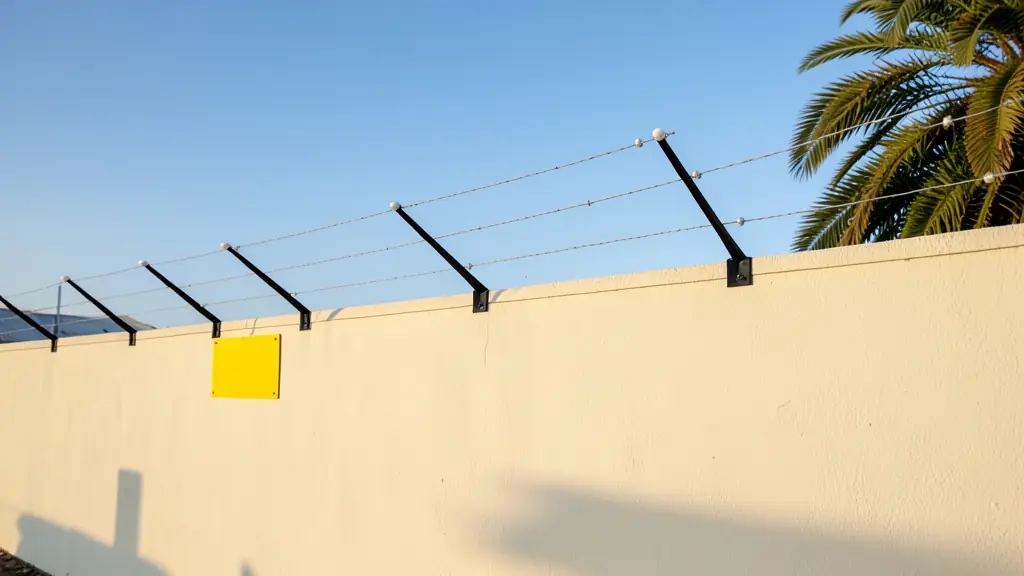
An electric fence quote is mostly wire and brackets, and both scale with the metres. This calculator takes the length of your wall or boundary, wall top brackets or free standing posts, the number of strands and the gates in the line, and counts the wire with a little extra for tensioning, the brackets or posts, the warning signs, the earth spikes and a rough price. The spacings come from South African summaries of SANS 10222-3. The electric fencing page explains energisers, zones and the certificate.
How each count is made
- Wire: length x strands, plus 5% for tensioning, tie offs and joins (our default).
- Brackets or posts: one every 3 m plus one at the end, from installer guides.
- Warning signs: one every 10 m, the spacing South African summaries of the standard give for urban fences, plus the ones at each gate.
- Earth spikes: one for every 10 m, from guidance of at least three per 30 m.
Corners, steps in the wall and strain posts add brackets; walk the line before you trust the count.
Strands, height and gates
Homes usually have six to eight strands; high security sites twelve or more. More strands make it harder to climb through, but add wire, insulators and cost.
Every gate breaks the fence. Each needs an undertrench cable to carry the pulses past it, or a gate contact so opening it alarms. A sliding gate with its own motor and beams also needs space so strands and the motor do not touch.
Energisers are limited to 5 joules a pulse; ask the installer for the energiser's rating.
A monthly check you can do
- Walk the line and cut back any plants touching the strands.
- Look for slack or broken strands and cracked insulators.
- Read the energiser's voltage on its keypad or with a fence tester.
- Test the siren and the link to your alarm or armed response.
- Check the earth spikes are not dry and their cable is sound; water them in a long dry spell.
- Make sure every warning sign is still in place.
From the counts to quotes
Send the length, mounting, strands and gates on the request below. Installers can quote the same scope: brackets or posts, wire, insulators, the energiser and its joules, the battery, the keypad and siren, earth spikes, signs, gate cables or contacts, and the link to the alarm. Ask that the electric fence system certificate is issued by a registered installer when the work is done, and keep it for when you sell. For a fence that already alarms, see electric fence repairs.
Sources
- South African business news, rules for electric fences at home: SANS 10222-3 (2023, edition 5.1) and the Electrical Machinery Regulations; warning signs no more than ten metres apart in urban areas, and at gates and corners
- Fencing installer, electric fence regulations in South Africa: energiser at most 5 J per pulse, pulses under 10 ms at least 1 s apart, at most 10,000 V; earth spikes at least 1.2 m deep; signs at every gate and no more than 10 m apart; wall top fences at least 1.5 m above the public side
- South African quote site, electric fence installation guide: posts no more than 3 m apart; yellow signs at least 100 x 200 mm, no more than 10 m apart in urban areas; wall top fences at least 1.5 m above ground; an electric fence system certificate from a registered installer
- South African home services site, electric fence design guide: at least three earth spikes per 30 m of fence; wall top brackets about 3 m apart; signs no more than 10 m apart; live wires at least 1.8 m above natural ground
- South African home services site, electric fence cost guide: standard home fences have 6 to 8 strands, high security 12 or more; energisers of 4 to 6 J for homes
- South African home services cost guide, electric fence prices: VAT n/s, labelled 2025: wall top 6 to 8 strands R100 to R170 a metre, 12 strands R250 to R300 a metre, free standing R215 to R400 a metre; energiser R2,500 to R7,800; call-out R500 to R950
- South African quote comparison site, electric fence price guide: VAT n/s, labelled 2026: installed R300 to R400 a metre, average R300 a metre
- Vanderbijlpark security wholesaler, electric fence category page 2: incl. VAT: 5 J energiser R3,067.74, 8 J energisers R4,378.74 and R5,479.98, 14 J energiser R7,144.95, 4 J energiser with 7 Ah battery R2,923.53
- Randburg security shop, two zone energiser product page: incl. VAT: two zone 7.6 J energiser R4,379 (sale, was R5,520), online price only
Frequently asked questions
How far apart must electric fence warning signs be?
Do I need a certificate for my electric fence?
Wall top or free standing: which costs more?
How do I get electric fence quotes?
More calculators and tools
- Access control plannerReaders, controllers, locks, exits, power and cable for your doors
- Maglock calculatorThe holding force class, bracket, current and supply for one door
- Backup battery calculatorThe battery in amp hours to carry readers and locks through outages
- Gate motor calculatorMotor class by gate mass and width, and the cycles a battery gives
- Clocking terminal calculatorHow many clocking terminals clear the shift change in time
- Turnstile lane calculatorLanes of tripod, speed gate or full height turnstile for your peak
- Biometric error rate calculatorFalse rejects and false accepts in people a day at your door