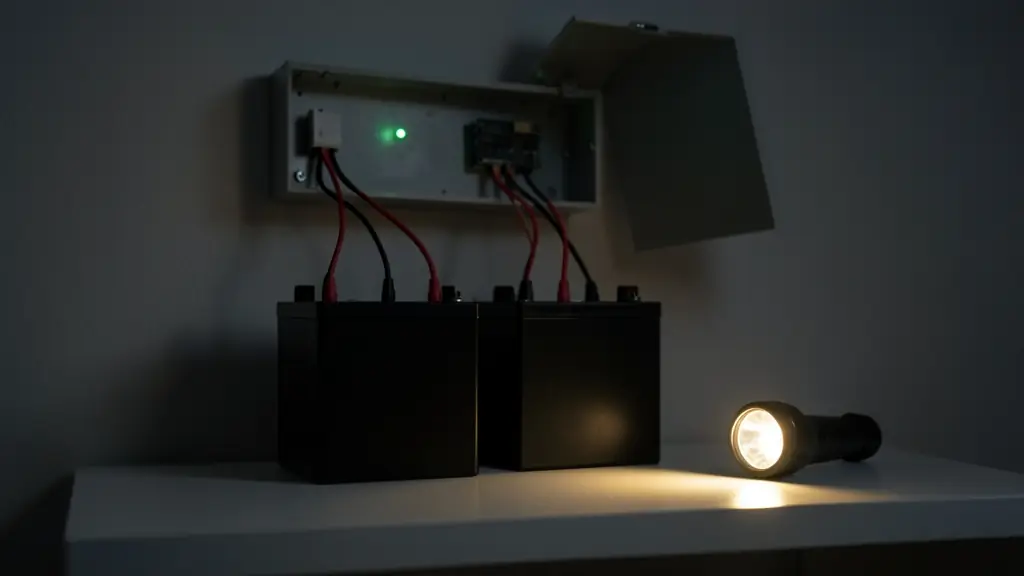
Two hours into stage six, the maglocks on a supply with a tired 7 Ah battery let go and the back door stands open. Size the battery before that happens. Pick the readers, terminals, locks, controllers and door station on one supply, or type a load in milliamps, set how many hours it must last, and this calculator gives the amp hours with margins for battery age and usable capacity, then the nearest 12 V size. Doors and wiring are on access control installation.
The sum behind the answer
Battery amp hours = load in amps x hours x 1.25 / 0.8.
The load is each part's working current at 12 V from makers' datasheets, added up. The 0.8 is the share of a sealed lead acid battery you should plan to use: battery sizing guides limit it to 80% depth of discharge. The 1.25 is the ageing factor used in battery sizing practice for lead acid, so the battery still carries the load at the end of its life, when it holds only 80% of its rating. Change any part count or the hours and the answer follows.
What the result tells you
- Load at 12 V: what the supply gives with mains on, and the battery gives with mains off.
- Amp hours used: the bare load times the hours, before any margin.
- Battery needed: with both margins.
- Battery to buy: the next common size up, or several of the biggest in parallel.
Sizes listed are our defaults for 12 V batteries commonly sold; change them if your supplier stocks others. Two batteries of the same size and age can run in parallel when one is not enough, but never mix an old one with a new one.
A routine for the battery you already have
- Read the date on the battery; three to five years is a common life in a warm cabinet.
- Switch off the mains to the supply for an hour during the day and watch the doors.
- Measure the battery voltage at the end; a reading far below 12 V means it is spent.
- Check the charger output on the board matches the battery size.
- Look for a swollen case or white crust on the terminals, and replace it if you see either.
Using the number on a quote
Ask every installer to state the backup time in hours for each supply, the battery size and its make up, and whether the charger suits that size; a big battery on a small charger never fills between outages. Put the hours you need on the request below. If the load is large, ask about running the supply from the inverter instead. The access control planner sizes the supply for the whole site, and the maglock calculator gives each lock's current.
Sources
- Battery conference paper, ageing factors in battery sizing: IEEE 485 sizing for lead acid uses an ageing factor of 1.25, so a battery at its end of life (80% of rated capacity) still carries the load: 80% of 125% equals 100%
- Engineering calculator, UPS battery sizing for physical security: Ah = load x hours / (efficiency x volts x usable depth of discharge); sealed lead acid (VRLA) limited to 80% depth of discharge; lithium (LiFePO4) 90 to 95%
- Access control maker, fingerprint terminal datasheet: power supply DC 12 V 1 A; power consumption up to 4.0 W standby and up to 6.0 W working (500 mA at 12 V); 3,000 fingerprints, 30,000 cards, 30,000 users, 150,000 records; fingerprint comparison time 1.5 s; 1:N and 1:1
- Access control maker, face recognition terminal datasheet: DC 12 V 2 A supply; power consumption 12 W (1,000 mA at 12 V); 50,000 faces; 100,000 records; face recognition 0.35 s; face to camera 0.3 to 2.0 m
- Access control maker, 13.56 MHz card reader datasheet: 9 to 15 VDC, 100 mA; up to 0.9 W standby and 1 W working (about 83 mA at 12 V); 13.56 MHz cards
- Reader maker, 125 kHz proximity reader and keypad datasheet: +5 to 16 VDC; current draw 70 mA typical, 110 mA peak at 12 VDC; read range up to 176 mm; Wiegand; IP67
- Access control maker, two door controller datasheet: two doors; power consumption up to 3 W (250 mA at 12 V) before readers and locks; supplies 4 readers at 12 V, 500 mA or less each, and 2 locks at 12 V, 1.2 A or less each; 100,000 users and cards, 500,000 records; 4 RS-485 reader ports and 4 Wiegand inputs
- Maglock maker, single door magnetic lock specification: 180 kg (350 lbs): 12 V 300 mA, 24 V 150 mA; 280 kg (600 lbs): 12 V 500 mA, 24 V 250 mA; 500 kg (1200 lbs): 12 V 420 mA, 24 V 210 mA; 12/24 VDC by jumper; the plate pivots on a rubber washer to take up small misalignment
- Lock maker, electric strike datasheet: dual voltage 12/24 VDC; current draw 250 mA at 12 VDC, 150 mA at 24 VDC; fail safe or fail secure chosen on site; holding strength 700 kg
- Intercom maker, IP video door station datasheet: 12 VDC 1 A or PoE; up to 2.5 W standby and up to 5 W working (about 420 mA at 12 V)
- Online shopping site, Johannesburg electronics seller, 12 V 7 Ah battery listing: VAT n/s: 12 V 7 Ah lead acid battery R220, in stock
- Randburg security shop, 12 V 7.2 Ah battery product page: incl. VAT: 12 V 7.2 Ah sealed lead acid battery R235
- Online shopping site, Johannesburg security seller, access control power supply listing: VAT n/s: 13.6 V 3 A access control power supply in a lockable metal box R859, 7 Ah battery not included; listing closed
Frequently asked questions
How many hours of backup should I plan for?
Can I use a lithium battery instead of lead acid?
Why does the calculator add so much margin?
Who can fit a bigger battery?
More calculators and tools
- Access control plannerReaders, controllers, locks, exits, power and cable for your doors
- Maglock calculatorThe holding force class, bracket, current and supply for one door
- Gate motor calculatorMotor class by gate mass and width, and the cycles a battery gives
- Clocking terminal calculatorHow many clocking terminals clear the shift change in time
- Turnstile lane calculatorLanes of tripod, speed gate or full height turnstile for your peak
- Biometric error rate calculatorFalse rejects and false accepts in people a day at your door
- Electric fence calculatorWire, brackets, warning signs and earth spikes for your fence