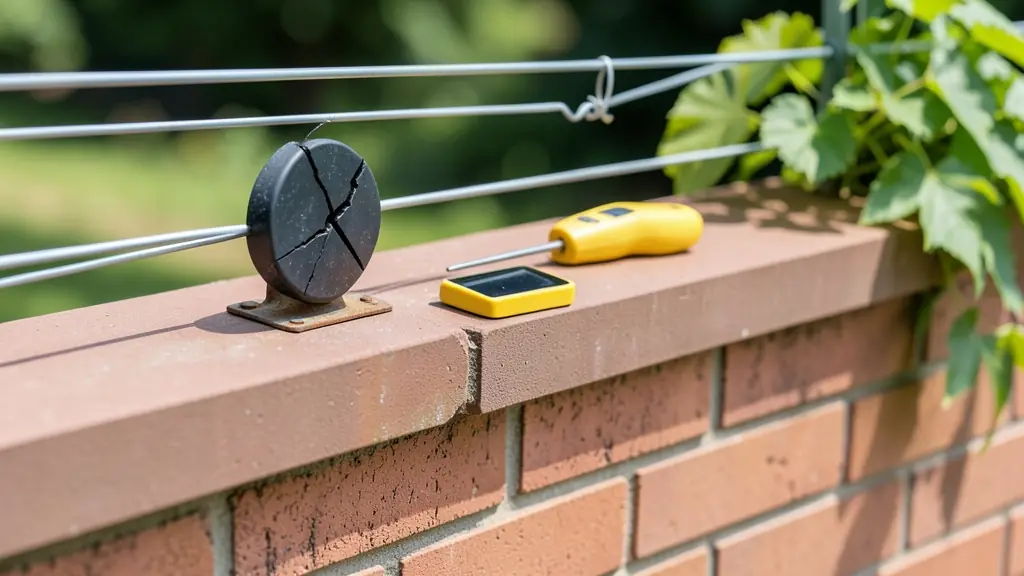
The keypad beeps at two in the morning, the siren goes off every time the wind blows, or the fence simply reads lower than it used to. Before anyone sells you a new energiser, rule out the cheap causes. Most faults sit on the fence line itself: a creeper touching a strand, a cracked insulator, a wire that has sagged onto a bracket, or an earth that dried out over winter. This page lists the usual faults, explains how a technician tests a fence, and gives you a short monthly check.
What the fault usually is
- Alarms after wind or rain: plants or branches touching a strand, or a slack wire swinging onto a bracket.
- Voltage low on one zone only: a cracked or burnt insulator, a broken joint, or growth along that stretch.
- Constant "fence cut" alarm: a broken strand, often at a corner or the gate crossing, or a loose link wire at the energiser.
- Fence low in dry months, fine after rain: the earth spikes sit in dry soil and the earth return is weak.
- Dead after a storm: lightning has damaged the energiser, its fuse or the keypad.
- Fence dies during load shedding: the battery no longer holds a charge.
- Keypad blank or siren silent: the keypad, its cable or the siren, not the fence.
How a technician tests a fence
A technician uses a fence tester to read the voltage on each strand and zone, then walks the line to see where it drops. A sharp drop after one bracket points to a short or a broken insulator there. They check the earth separately, because a fence can look healthy on the energiser and still give a weak shock if the earth is poor.
Never open the energiser yourself. If the fence was changed or rebuilt, ask for a new electric fence system certificate, which a registered installer must issue after alterations. If the gate motor also died in the same storm, see gate motor repairs.
A monthly check you can do from the ground
- Look at the keypad: note which zones show faults and what the voltage reading is, if it shows one.
- Walk the fence line and look for plants, branches, washing lines or debris near the strands. Cut growth back with the fence switched off.
- Look for sagging strands, broken insulators and loose brackets, and write down where they are.
- Check the warning signs are still in place.
- Look at the earth spikes: still in the ground, clamps tight, no broken earth wire. In a long dry spell, ask your installer whether watering them helps.
- Once a quarter, during load shedding, check the fence stays armed on its battery.
Repair, upgrade or replace
Strands, insulators and joints are cheap to fix and should be done properly with crimped joints, not twisted knots. An energiser that has taken a lightning strike may be repairable or may not be worth it; a technician can tell you after testing. A fence patched for years, with rusted brackets and mixed wire, is often better rebuilt.
When the work is bigger, compare the price of a repair with a new section on the electric fence calculator, and read electric fencing for what a new installation should include.
What to put in your request
- Say what the keypad shows and which zone
- Say when the fault started, after a storm or not
- Give the rough length and age of the fence
- Ask for the call-out fee and the hourly rate
- Ask whether a new certificate will be needed
Electric Fence Repairs for homes, estates, offices, factories and schools
- Homes: a fence that alarms at night because the bougainvillea has grown into the strands
- Estates, complexes and body corporates: a long perimeter where one zone keeps faulting and the guards ignore the alarms
- Offices and practices: a wall top fence on an office park left dead since the last power surge
- Factories, warehouses and mines: a yard fence with rusted brackets and broken insulators along the back boundary
- Shops, restaurants and filling stations: the back wall of a shop where bins and pallets lean against the strands
- Schools, colleges and creches: a perimeter fence damaged by balls, branches and vandalism along the sports fields
- Clinics, hospitals and pharmacies: a clinic fence that loses voltage every winter as the earth spikes dry out
- Farms, smallholdings and lodges: a solar fence with a tired battery and grass growing onto the bottom strand