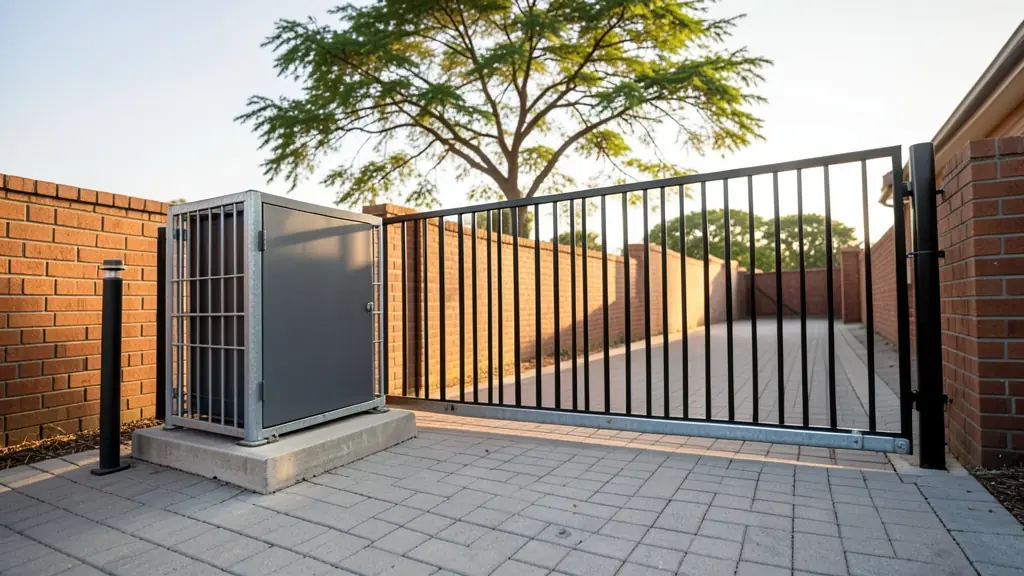
Plenty of gate motors that give trouble in their first year were fitted to a gate that was already fighting them: a sagging leaf, a bent track, wheels that grind. The motor is the easy part to choose once you know three things about the gate: how it moves, what it weighs and how many times a day it opens. After that come the battery that carries it through load shedding, the beams that stop it on a car, and the cage that keeps it on its plinth.
Sliding or swing: the gate usually decides
A sliding gate motor sits on a plinth beside the opening and drives a toothed pinion along a rack fixed to the bottom of the gate. It needs a clear run along the wall for the gate to slide into, and a level track.
A swing gate motor is an arm, or a pair of arms, bolted between the pillar and each leaf. It suits a driveway with no room to slide, or a farm entrance. Swing leaves catch the wind like a sail, and a sloping driveway can stop them opening fully, so measure the slope before you choose. Where cars queue at a complex, a boom gate may serve better than either.
Mass and cycles, not the price tag
Motors are sold in classes by the gate mass they can move and the cycles a day they are built for (one open and close is a cycle). A light aluminium gate at a family home and a heavy steel gate at a complex of forty units need different classes, even at the same width.
- Estimate the mass honestly: solid steel cladding adds a lot.
- Count the traffic: school runs, a domestic worker, deliveries and visitors all add cycles.
- Leave headroom: a motor at its limit wears sooner.
The gate motor calculator takes the type, width, mass and cycles and gives the class and the battery cycles in a power failure.
Fix the gate before the motor goes on
- Push the gate by hand along its full travel. It should roll with one hand and not stick at any point.
- Replace wheels that are flat spotted or seized.
- Look at the track: it must be straight, level and fixed down, with no dips where water stands.
- Check the guide rollers at the top hold the gate upright without binding.
- Fit end stops so the gate cannot run off the track.
- On a swing gate, check the leaf does not drop at the far end.
Battery, beams, remotes and the cage
Most motors run from a 12 V or 24 V battery that the mains, or a solar panel on a farm, keeps charged. The battery decides how many cycles you get when the power goes off, so ask what size is quoted. Infrared safety beams across the opening and collision sensing on the motor stop the gate on a car or a child; insist on both.
Ask for an anti-theft cage bolted into the plinth, because motors are stolen. For opening, remotes are only the start: a keypad, a tag reader or a gate intercom can trigger the same motor, and an electric fence often runs along the same wall.
What to put in your request
- Say if the gate slides or swings, and its width
- Describe the gate material and cladding
- Estimate how many times a day it opens
- Ask for the battery size and the cycles it gives
- Ask for beams and a cage in the price
Gate Motors for homes, estates, offices, factories and schools
- Homes: a sliding or swing driveway gate with remotes, beams and battery backup for load shedding
- Estates, complexes and body corporates: a busier class of motor on the complex gate, triggered by tags, keypads or the guardhouse
- Offices and practices: the staff parking gate, opened from reception or by the access control system
- Factories, warehouses and mines: a heavy steel depot or factory gate rated for many cycles a day
- Shops, restaurants and filling stations: the delivery yard gate behind a shop or filling station, opened for trucks
- Schools, colleges and creches: the staff and parents' vehicle gate, opened at set times and closed in between
- Clinics, hospitals and pharmacies: the ambulance and staff gate at a clinic, opened quickly from the front desk
- Farms, smallholdings and lodges: a wide farm gate far from the house, kept charged by a solar panel